Veterans Are Patients, Not a Political Talking Point
By ALDP Co-Founders Michael Glassner and Jason Young
As the 2026 state legislative season unfolds, some state legislatures are taking up bills that would mandate significant changes to pharmacy ownership – legislation largely modeled on Arkansas Act 624 that would force divestitures of pharmacies based on their ownership structure. In several of these states, supporters have pointed to exemptions for VA facilities as evidence that veterans are protected. We are concerned that framing creates a false sense of security, and we want to explain why.
These bills do not lower drug prices. They do not reduce what patients pay at the counter. By reducing the number of pharmacies competing for patients’ business and increasing the time and transportation burdens patients face to reach a pharmacy, they stand to raise the true cost of care – costs that fall hardest on those in rural communities and those living with disabilities. Worse health outcomes from disrupted medication access are a real cost too, even if they never appear on a receipt. Veterans are disproportionately represented in both of those groups, and a carve-out for VA facilities does nothing to protect them.
Most Veterans Don’t Use VA Pharmacies
A landmark 2024 study in JAMA Network Open by researchers at the VA Health Economics Resource Center and Stanford University found that only about one-third of veterans are enrolled in VA health coverage. The other two-thirds use private insurance, TRICARE, Medicare, or some combination. They fill their prescriptions at retail pharmacies, through mail-order services, and at specialty pharmacies in the same commercial market that divestiture legislation would directly affect.
The states where these bills are advancing have large veteran populations that reflect this reality. Pennsylvania has more than 650,000 veterans. Tennessee has more than 400,000. Oklahoma has nearly 250,000. Louisiana has more than 215,000. In every one of these states, the clear majority of those veterans are navigating the private pharmacy market, not the VA system. A carve-out that protects VA facilities (which are federal institutions the state cannot regulate in the first place) offers those veterans nothing they did not already have.
The JAMA study also found that veterans most likely to rely on the VA tend to be those with worse health and lower incomes. Working-age veterans, National Guard and Reserve members, and retirees on TRICARE are deeply integrated into the commercial pharmacy system. A VA facility exemption is tangential to the debate, not central to it.
Veterans Have Complex Medication Needs
This is not an abstract concern. Veterans experience higher rates of PTSD, depression, anxiety, bodily injuries, traumatic brain injury, chronic pain, and conditions toxic exposures (think burn pits and contaminated water at installations like Camp Lejeune). Many of the medications used to treat these conditions are filled through retail or mail-order pharmacies in the private market, not through the VA.
Further, the scale of disability in the veteran population is substantial and growing. A 2024 U.S. Census Bureau report found that roughly 30% of veterans had a service-connected disability in 2022 – double the share from 2008. Veterans with mobility, cognitive, or other disabilities face greater barriers to reaching a pharmacy when access is disrupted – and they are far less able than the average patient to simply drive to the next-nearest option when a local pharmacy closes.
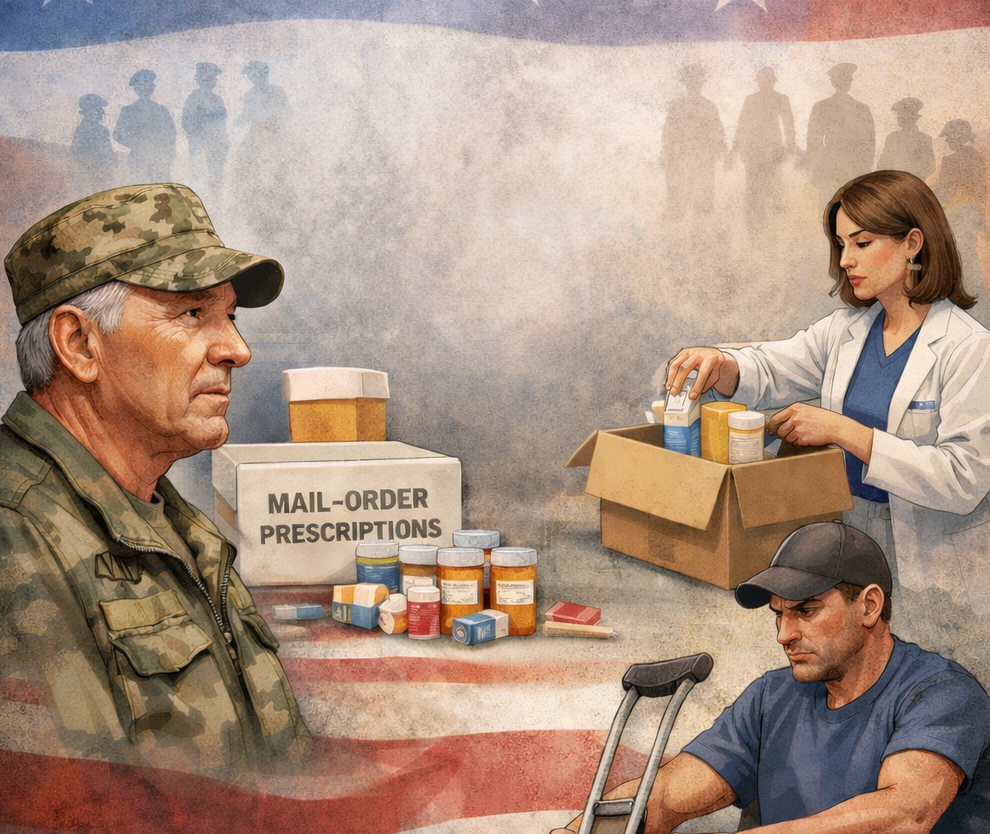
Survey data tell us TRICARE beneficiaries are four times more likely to use mail-order pharmacy services compared to the general population. For many rural veterans and military families, the mailbox genuinely is the pharmacy counter. Legislation that mandates ownership changes to mail-order pharmacy infrastructure does not leave these families untouched. And for veterans managing serious mental health conditions, disruptions in medication access are not inconveniences; they carry real clinical risk.
Pharmacy Deserts Make This Worse
In many of these states, veterans are already operating with fewer pharmacy options than the national picture suggests. Twenty-one of Louisiana’s 64 parishes – nearly a third – already contain pharmacy deserts, concentrated in the rural north and west of the state. A third of Tennessee counties are pharmacy deserts. Half of Oklahoma’s counties are. In Pennsylvania, 16 of 67 counties face the same problem, particularly in the rural central and northern parts of the state.
In communities like these, a veteran’s neighborhood pharmacist is often the most accessible health care professional they see regularly – someone who knows their full medication list, can catch dangerous interactions, and serves as a first point of contact when something goes wrong. When a rural pharmacy closes because the state changed ownership requirements, it closes for everyone. A pharmacy cannot close for civilians and remain open only for veterans. The VA facility carve-out does not change that arithmetic.
At ALDP, we believe the right approach to meeting rural communities’ pharmacy needs is a both/and approach: we need every kind of pharmacy currently serving communities to continue to be available – independent retail pharmacies, chain retail pharmacies, mail-order services, and specialty pharmacies. Taking several of these options off the table doesn’t level the playing field – it obliterates it.
What Would Actually Help
The VA has accomplished something the rest of the American drug pricing system has largely failed to do: it negotiates prices aggressively on behalf of its enrollees, delivering medications at dramatically lower cost than the commercial market. The lesson is not to protect VA facilities from state regulation – they already are. The lesson is to apply the same principle to the commercial market, through mechanisms like Prescription Drug Affordability Boards, so that the two-thirds of veterans outside the VA system pay lower prices too.
Pharmacy divestiture bills do not lower drug prices. They do not reduce what a veteran pays at the counter. They restructure pharmacy ownership in ways that the evidence consistently shows will reduce access, particularly in rural communities that are already underserved. For any policymaker concerned about fair reimbursement, as we are, we believe that reimbursement reform is the right way forward – not eliminating options that people depend on today.
Veterans have earned genuine protection. That means lower drug prices, stable pharmacy access close to home, and policies built around their actual health care needs.
Sources:
Wagner TH, Schmidt A, Belli F, et al. “Health Insurance Enrollment Among U.S. Veterans, 2010–2021.” JAMA Network Open. 2024;7(8):e2430205.
Veteran population figures from the U.S. Department of Veterans Affairs, 2023.
Disability data from U.S. Census Bureau, “Trends in Veteran Disability Status and Service-Connected Disability: 2008–2022 (ACS-58),” November 2024.