The Clock Is Ticking: Why States Must Act Now on Drug Prices (Part 2 of 2)
By ALDP Co-Founders Michael Glassner and Jason Young
In Part 1 of this series, we gave the Trump administration real credit for TrumpRx.gov, and we meant it. Political will matters. Forcing the pharmaceutical industry to the table matters. And the patients gaining access to medicines through the platform are genuinely better off.
But we also told you the part the industry hoped you’d miss: some of those TrumpRx agreements last only three years. The clock is already running. And that changes everything about what needs to happen next.
A Three-Year Window Isn’t a Lasting Solution
Think about what a three-year pricing agreement actually means for a patient. Suppose you are a working American with obesity and early cardiovascular disease. You gain access to a GLP-1 medication through TrumpRx at an affordable price. Over three years, your health improves measurably. Your doctor adjusts your treatment plan around the assumption that you will continue this medication. And then, in year four, the manufacturer’s voluntary agreement expires, the price snaps back, and you are right back where you started – except now you have a demonstrated medical need, an established treatment relationship, and no affordable way to continue.
That is not a solved problem. In some ways, it risks becoming a temporary oasis rather than lasting reform.
The pharmaceutical industry understands this dynamic very well. Drugs with high adherence and difficult discontinuation profiles – the class of medications most visible in TrumpRx – are more ideal candidates for a three-year access program, because the patients who come to depend on them will face the hardest consequences when the program ends. We are not aiming to be cynical; rather, we just want to observe and document a concerning set of facts.
What the International Experience Tells Us
Germany, Japan, Canada, and most of our peer nations have functioning, modern, innovative pharmaceutical markets – and they pay much lower prices for the same drugs. Their pharmacies are economically sustainable. Their patients are not rationing medication like Americans are. Their manufacturers are still investing in research and development.
The American pharmaceutical industry has spent decades arguing that lower prices would destroy innovation. The international evidence says otherwise. And TrumpRx, by demonstrating that manufacturers will participate in MFN-benchmarked pricing when they have to, adds another data point to that pile. If Eli Lilly or Novo Nordisk can sell a GLP-1 at an MFN price through TrumpRx and remain viable, they have just conceded the central argument they have made for twenty years.
ALDP intends to make sure that concession does not get forgotten when the three-year agreements expire.
Why States Are the Answer – and Why PDABs Are the Mechanism
TrumpRx is a federal initiative. One month in, it covers 55 drugs now, operates on a voluntary manufacturer participation model, relies on confidential agreements, and expires on a timeline determined by the industry’s negotiators rather than patients’ needs. It is, in a way, an important proof of concept.
Prescription Drug Affordability Boards are the structural solution. And they operate at the state level – which means that lawmakers have an opportunity to deliver genuine, lasting drug price relief to their constituents without waiting for Washington. Put another way, a PDAB is a lasting extension of TrumpRx and other important federal initiatives.
Here is how a PDAB works. A state-chartered board of independent experts reviews the clinical and economic evidence for high-cost drugs and sets upper payment limits – the maximum price that can be charged in that state. Manufacturers selling drugs in the state must comply with the limit. There is no voluntary participation, no confidential side deal, no sunset clause. The limit applies, it is transparent, and it protects patients for as long as the law is in effect.
Further, a PDAB does not change who dispenses your medication. Your local pharmacist – including the independent or chain pharmacy in a rural community that may be the only health care touchpoint for miles – remains your pharmacist. The drug just costs less when it enters the supply chain, which benefits every patient regardless of insurance status, geography, or technical sophistication. You do not need a smartphone, a credit card, or a federal website. You just fill your prescription.
The Rural Patient Cannot Wait
We want to be specific about who is most at risk if we fail to act. Roughly one in three rural Americans lives in a pharmacy desert – an area without a pharmacy within ten miles. For these patients, whatever existing local health care access they have is crucial. That relationship depends on local pharmacies remaining financially viable, which in turn is shaped by reimbursement systems built around high manufacturer list prices.
A PDAB that lowers the list price of brand-name drugs reduces acquisition costs for rural pharmacies, reduces the magnitude of the losses they absorb on every underpaid brand prescription, and makes it more financially viable for them to stock the medications their patients need rather than turning patients away – or seeing the patients decline a prescription due to costs. At a moment when drug manufacturers are experimenting with direct-to-consumer (DTC) sales models (e.g., the Novo Nordisk/Hims & Hers agreement), one could say local pharmacies are at risk of disruption. But PDABs require no such change and can work well with the pharmacies patients already trust.
The rural patient is also the patient least likely to benefit from a DTC digital platform and most likely to be harmed by the fragmentation of their medication record that results when brand drugs go through one channel and generics go through another. For the rural patient, the PDAB is not an abstract policy preference. It could well be the difference between their pharmacy staying open and closing.
The Timeline Is Specific and the Stakes Are High
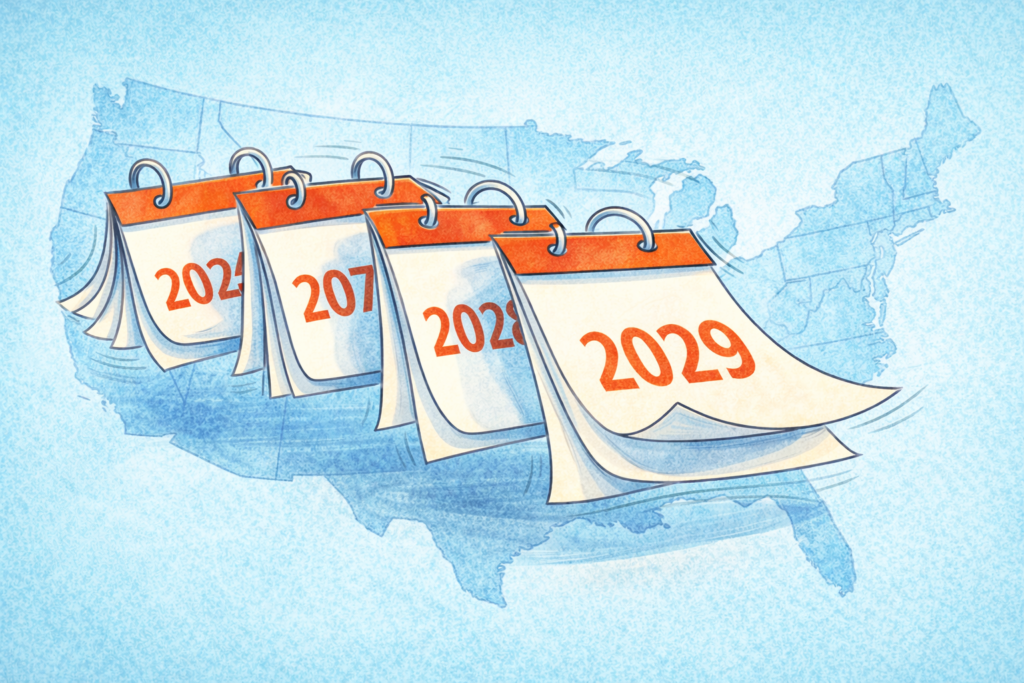
If TrumpRx agreements were signed in late 2025 and early 2026, a three-year term puts their expiration in 2028 and 2029. State legislatures, which operate on two-year sessions, have roughly one to two full cycles to act before those agreements expire and prices snap back. That is a specific window, and it is finite.
ALDP is working in states across the country – in Republican-controlled legislatures and Democratic ones, in states that have already passed PDAB legislation and in states where the fight is just beginning – to build the durable infrastructure that lasts beyond any one administration. We are building coalitions of patients, small business owners, pharmacists, and taxpayers who understand that high drug prices are not an act of nature. They are a policy choice, and they can be unmade by a better one.
The pharmaceutical industry is betting that TrumpRx will be enough to satisfy the public’s demand for reform, that the three-year agreements will buy enough time for the political momentum to dissipate, and that when those agreements expire, the debate will start over from scratch. We are betting the opposite. We believe that TrumpRx has proven the premise – manufacturers will move when they must – and that the patients who have seen what lower prices look like will not accept going backward.
We have three years to make sure they don’t have to.
What You Can Do
Find out whether your state has a Prescription Drug Affordability Board – or legislation to create one. Contact your state legislators – both Democrats and Republicans – and ask them where they stand. Share your story about what high drug prices have cost you and your family. And if you want to join us in this fight, learn more, take action, and follow ALDP on social media.
The window is open. The evidence is in. The clock is running. Let’s get to work.