Not All Prescription Drug Affordability Boards Are the Same
By ALDP Co-founders Michael Glassner and Jason Young
July 8, 2026 – State lawmakers across the country increasingly ask us the same question: “Should our state create a Prescription Drug Affordability Board?”
Our answer is yes. The harder – and more important – question is how to design one that addresses a state’s unique challenges while standing the test of time.
As more states consider Prescription Drug Affordability Boards, we’ve noticed that the conversation often treats them as though they’re all the same.
They are not.
Several years ago, “Prescription Drug Affordability Board” described a fairly specific policy idea. Today, it describes something much broader.
As states have searched for ways to improve accountability and address high prescription drug costs, they have begun taking different approaches to the same problem. Some, like Louisiana, emphasize transparency. Others, like Colorado, Maryland, and Washington, conduct independent affordability reviews. Still others, like Minnesota, are beginning to build upon Medicare’s newly negotiated drug prices.
These approaches share a common goal: bringing greater accountability to prescription drug pricing while making medicines more affordable for patients, small businesses, taxpayers, and state governments. But they pursue that goal in different ways.
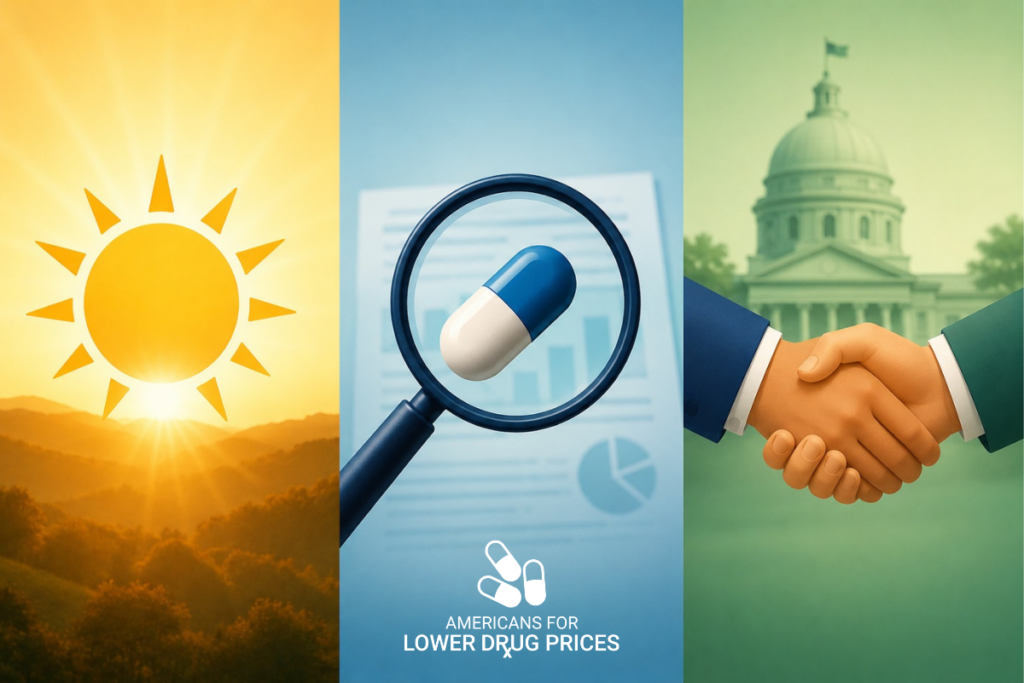
At Americans for Lower Drug Prices, we’ve found it useful to think of today’s Prescription Drug Affordability Boards as three distinct approaches.
The Sunshine PDAB
The first approach begins with a simple principle: good public policy begins with good information.
Rather than setting prices, Sunshine PDABs are designed to bring transparency to one of the least transparent areas of American health care.
Their work typically includes:
- Identifying high-cost medicines.
- Collecting information about pricing, research and development investments, public funding, launch prices, price increases, and other factors influencing affordability.
- Hearing directly from patients – especially uninsured patients – as well as small businesses, providers, and communities about the local consequences of high drug prices.
- Publishing findings to help legislators make better-informed decisions.
Their purpose is straightforward: replace speculation with evidence.
Louisiana’s recently enacted SB 401 reflects this approach. Oregon has implemented a similar transparency-focused model. The pharmaceutical industry challenged Oregon’s law in federal court but ultimately did not prevail on appeal.
Transparency alone will not solve the affordability crisis.
But transparency has repeatedly improved public accountability. Financial disclosures, environmental reporting, restaurant inspections, nursing home quality ratings, and hospital price transparency all reflect the same governing principle: when important information becomes public, markets and policymakers make better decisions.
Prescription drug pricing should not be beyond public scrutiny. That is especially true given the significant public investment in discovering, developing, and purchasing many of these medicines.
The State Review PDAB
A second approach asks states to do more than collect information.
State Review PDABs conduct drug-specific affordability reviews and, where authorized by law, may establish Upper Payment Limits (UPLs) for medicines determined to be unaffordable.
Colorado’s board is the best-known example. Maryland and Washington have adopted similar approaches.
These boards ask necessary and important questions.
- Is a particular medicine affordable for patients and purchasers?
- What evidence should policymakers consider when evaluating affordability?
- When, if ever, should a state establish a payment limit?
In October 2025, Colorado’s PDAB established a UPL, which industry has challenged in court. The litigation raises important constitutional questions about the relationship between federal patent rights and state authority to protect consumers. Those questions deserve careful consideration.
But they also raise another question that matters every bit as much to patients: should a federal patent give a company complete pricing immunity from reasonable state efforts to address unaffordable medicines?
That conversation is far from over.
Regardless of how the Colorado litigation ultimately concludes, State Review PDABs have already changed the national discussion by focusing attention on some of the medicines placing the greatest strain on patients, employers, taxpayers, and state budgets.
The Fair Price PDAB
A third approach has emerged following Congress’s creation of Medicare’s Drug Price Negotiation Program.
Rather than asking a state board to develop its own payment methodology, Fair Price PDABs build on the prices the federal government has already negotiated with manufacturers.
Medicare’s Maximum Fair Prices took effect for the first ten medicines on January 1, 2026. Another fifteen negotiated prices will take effect on January 1, 2027. Fifteen additional medicines are scheduled to follow in 2028.
Minnesota has already incorporated one version of this concept into state law.
Other states may pursue different variations.
One promising approach would begin by applying Medicare’s negotiated prices to a state’s own employee and retiree health plans before considering broader applications elsewhere in the market. States have long exercised broad authority over how taxpayer dollars are spent and how they administer their own programs. Beginning there allows policymakers to measure savings, monitor patient access, evaluate provider impacts, and build practical experience before deciding whether additional steps are warranted.
Like every significant policy innovation, these ideas will continue evolving as states gain experience and courts provide additional guidance.
Three Approaches, One Goal
One thing has become increasingly clear. There is no longer a single “PDAB model.”
Instead, states are pursuing different approaches to the same challenge.
Some begin with transparency, while others conduct independent affordability reviews and still others are exploring how Medicare’s negotiated prices can inform state policy.
Each reflects different priorities. Each raises different implementation questions. Each contributes to a broader understanding of how states can improve affordability while protecting patient access and encouraging continued innovation.
That should not be viewed as confusion. It should be viewed as progress.
For generations, states have served as laboratories of democracy, testing ideas, learning from one another, and refining public policy over time. Prescription drug affordability is proving no different.
Looking Ahead
At Americans for Lower Drug Prices, we believe state policymakers deserve practical options, not ideological purity tests.
Every state faces different challenges, and every legislature has different priorities. The best approach for one state may not be the best approach for another.
Our role is not to insist that there is only one path forward.
Our role is to help policymakers understand the growing set of tools available to improve affordability, protect access, and encourage healthy competition.
The conversation about prescription drug affordability has become more sophisticated over the past several years. That is good news, because patients deserve more than slogans. They deserve reforms that are thoughtful, effective, and durable.
Our goal is not simply to pass the most ambitious bill. It is to help states enact the most durable reforms: reforms that withstand legal scrutiny, earn public trust, and deliver lasting benefits for the patients who depend on affordable medicines.
Patients have waited long enough. Prescription drug pricing should not be a black box.