Medicare’s Hospital Fund Is Running Short. Drug Prices Are Helping Drain It – and Voters Decide Who Fixes It.
By ALDP Co-founders Michael Glassner and Jason Young
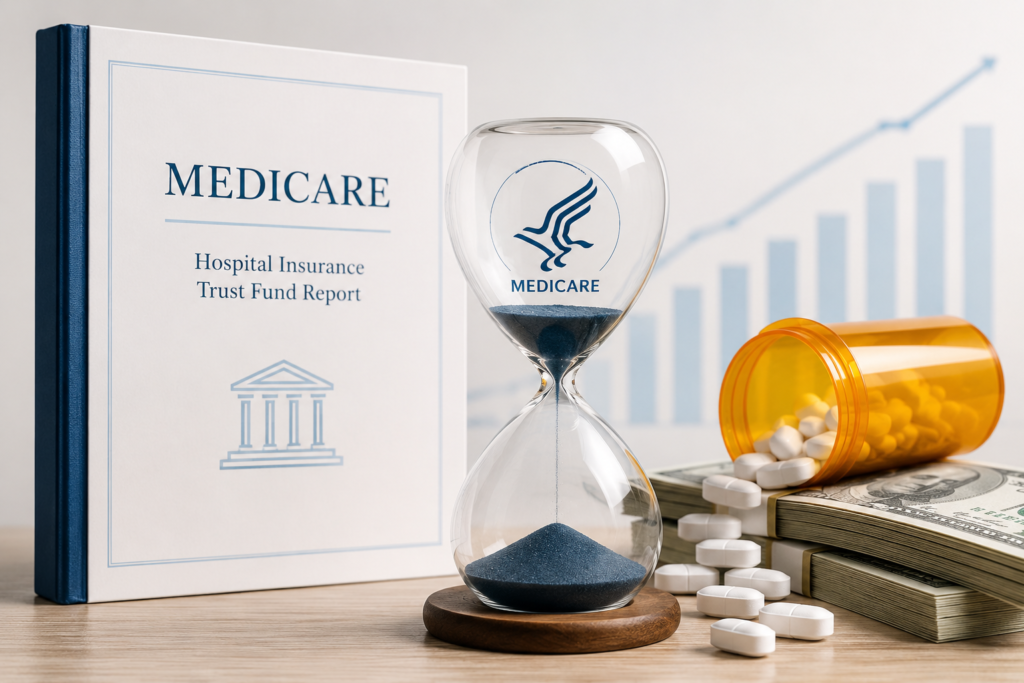
Every year, a small group of government officials called the Medicare Trustees publishes a report on the health of the program’s finances. It is dense, technical, and easy to ignore. This year’s edition, released June 9, should not be ignored. It tells us, in plain numbers, that the part of Medicare that pays for hospital care is now projected to run short of money in the first half of 2033 – and that the date moved closer, not further away, over the past twelve months.
That is not a distant problem for some future generation. If you are a 57-year-old worker today, you will be staring at it the year you turn 64. And if you are younger than that, you are in the same boat – and conceivably for the entirety of your retirement years. One of the key forces pushing the program toward that cliff is something you feel every time you pick up a prescription: the price of medicine.
What the report actually says
Medicare has several parts. The one in trouble is Part A, which covers hospital stays, skilled nursing, and home health care. It is paid for mainly through the Medicare payroll tax that comes out of every working American’s paycheck – money set aside in what’s called the Hospital Insurance trust fund.
That fund is now projected to be depleted in the first half of 2033. Last year’s report put the date a few months later. The fund starts spending more than it takes in beginning next year, in 2027. When the reserves run dry in 2033, the incoming tax revenue would only cover about 89 cents of every dollar of hospital benefits Medicare has promised. The shortfall grows from there.
The report also uses a measure called the “actuarial deficit.” Stripped of the jargon, it answers a simple question: over the next 75 years, how far apart are the money coming in and the money going out? The gap widened this year – from 0.42 percent of taxable wages to 0.56 percent. In everyday terms, the hole got bigger, and it got bigger faster than expected.
The Trustees are unusually direct about what that means. To close the gap today, you would have to raise the Medicare payroll tax from 2.9 percent to 3.46 percent, or cut hospital benefits by 12 percent – starting immediately. Wait until 2033, and the same fix requires far steeper changes squeezed into fewer years and borne by fewer people. Their own words: act “sooner rather than later.” (Social Security is on the very same clock: its companion report, released the same day, now projects the main retirement fund will run short in late 2032 – also sooner than last year – triggering an automatic benefit cut of about 22 percent if Congress does nothing.)
Where high drug prices come in
The report identifies higher prescription drug spending as an important reason Medicare’s spending projections came in higher this year than last. Two categories stand out:
- GLP-1 drugs. These are the blockbuster medications now widely used for diabetes and weight loss – names like Ozempic, Wegovy, and Mounjaro. Demand exploded in 2025, and so did the bill.
- Specialty drugs. This is the industry term for the most expensive medications on the market – typically complex treatments for conditions like cancer, rheumatoid arthritis, multiple sclerosis, and rare diseases. A single specialty drug can carry a list price of tens of thousands of dollars a year, and sometimes far more. They make up a small share of prescriptions but a very large share of spending.
Because of these two forces, the Trustees now project that Medicare’s prescription drug benefit – known as Part D, the coverage that helps roughly 50 million seniors and people with disabilities afford their medications – will grow at roughly 9 percent a year through 2030. That is more than double the growth rate of the overall economy. To see why that pace matters, look at where it leads. Medicare spent $181 billion on prescription drugs in 2025 – a sum larger than the entire economy of many U.S. states, and more than the federal government spends in a year running the Department of Veterans Affairs’ medical care system. If spending were to continue growing at roughly 9 percent annually, a $181 billion program would approach $360 billion in annual spending by 2033 – nearly doubling in just eight years. When a number that large grows that fast, it pulls the whole program’s finances along with it.
To be clear, Part D is financed differently from Medicare Part A and does not draw directly from the Hospital Insurance Trust Fund. But rising prescription drug costs increase Medicare’s overall spending burden, requiring larger taxpayer subsidies and placing additional pressure on the program’s long-term finances.
It’s worth noting what the report says quietly between the lines: where price restraint exists, the curve bends. The Trustees assume Part D will grow somewhat more slowly over the long run precisely because certain provisions now tie some drug-price growth to the rate of inflation. Take that restraint away, and the projections would be steeper still. In other words, what we pay for drugs is not a fixed fact of nature. It responds to policy.
And let’s be plain about how those prices got so high in the first place. Americans routinely pay two to three times more than patients in other developed countries for the very same medications – often the exact same pills, made in the exact same factories, just sold across a different border. For brand-name drugs, federal researchers have found the U.S. price runs more than three times higher even after the discounts manufacturers like to point to. That gap is not the cost of innovation or the price of doing business. It is a choice – made by drug manufacturers, year after year, because the American market has let them make it.
What’s striking is how easily the industry sidesteps responsibility for a problem it did so much to create. There is plenty of accountability to go around – insurers and pharmacy benefit managers (PBMs) have real questions to answer too, and we press those questions hard. But manufacturers set the list price, and we have grown so used to their reflex of pointing everywhere but the mirror that we almost expect it. The stakes here are too high and too lasting for that to be good enough. When the same pricing that strains family budgets is also contributing to rising Medicare spending, drug manufacturers do not get to stand on the sidelines. They are not solely responsible for Medicare’s fiscal challenges, but they are responsible for the prices they set. They should be part of the conversation about how to make prescription drugs more affordable for patients and taxpayers alike.
Why this is a question for the ballot box
Here is the part that matters most. The Trustees can do the math, but they cannot fix anything. Only Congress can change how these programs are funded, what they cover, and how hard we work to bring underlying costs – including drug prices – under control.
And the timeline has consequences for who makes that decision. With depletion now projected for 2032 and 2033, the lawmakers who will hold the gavel during the critical window are the ones Americans elect on November 3, 2026 – and again two years after that, and two years after that. The men and women who win those races will have more say over the future of Medicare and Social Security than almost anyone else in the country.
That makes this a fair and necessary question to put to every candidate, of either party, on the campaign trail: What is your plan? Not a slogan. A plan. Voters have every right to ask, and candidates have every responsibility to answer.
This is not a partisan point, and it cannot be solved by one party alone. The numbers don’t care who controls Congress. Closing a gap this size will take leaders from both parties willing to sit at the same table, put real options forward, debate them honestly, adopt the ones that work, and – yes – reject the ones that don’t. The Trustees themselves do not prescribe a specific solution. What they repeatedly emphasize is timing. The longer policymakers wait, the more abrupt and painful the eventual changes become.
What is not a responsible option is the one Washington has chosen for decades: doing nothing and letting the deadline do the deciding.
ALDP’s view
At Americans for Lower Drug Prices, we are a bipartisan organization, and we do not endorse candidates. But we are clear about this: prescription drug costs are one of the most important drivers policymakers can address without immediately resorting to higher payroll taxes or reductions in benefits.
That is why we believe closer scrutiny of these cost increases is not just warranted — it is essential. Every year the Trustees show us that drug spending is climbing. We need to understand, in detail, why: which drugs, which prices, which links in the chain. That kind of data is invaluable. You cannot monitor a problem you refuse to measure, and you cannot solve one you refuse to understand.
You paid into these funds with your hard-earned wages – paycheck after paycheck, for your entire working life. You are owed a government that treats the looming shortfall as the urgent, solvable problem it is, and leaders, in both parties, willing to do the work. The clock is running. In November, so are the people who can stop it. The question on the ballot isn’t only who represents you – it’s who will protect what you already paid for.
Americans for Lower Drug Prices is a bipartisan 501(c)(4) organization focused on state-level prescription drug pricing reform. ALDP does not endorse, oppose, or contribute to candidates for public office.