Old Medicine, Expensive Device: What Inhalers Cost Families Coping with Asthma (Part 1 of 2)

By ALDP Co-founders Michael Glassner and Jason Young
Sept. 2, 2026 – Pediatricians and asthma advocates have a name for the third week of September: Peak Week.
Children are back in school, colds pass through classrooms, ragweed peaks, and asthma attacks spike. Across America, it is one of the most predictable respiratory surges on the calendar. Every year it arrives on schedule, and every year some parents struggle to afford inhalers on a budget.
A parent managing a child’s asthma knows the logistics and the math. One inhaler needs to be at school, cleared through the nurse’s office with the right paperwork. One needs to be at home. Many children need both quick-relief medication for symptoms and anti-inflammatory treatment to prevent attacks, sometimes in separate inhalers.
None of this is new medicine. Albuterol was developed in the 1960s and has been used for more than half a century; it has been FDA-approved in the United States since 1981. So it is worth asking why a treatment this old is still priced like a breakthrough.
Old medicine, new device patents
Inhalers are drug-device combinations. In many inhalers, the active ingredients are decades old. Much of the later patent protection has focused on the delivery system – the canister, actuator, dose counter and other device components – so therein lies much of the market power.
The distinction matters legally. A manufacturer can list patents in the FDA’s Orange Book. One benefit to brand makers is that, when a generic applicant challenges the patent, brands can sue and trigger an automatic 30-month stay on the generic competitor’s approval. For years, inhaler makers listed device patents alongside drug patents, and generics stayed – or were kept – out.
In November 2023, the Federal Trade Commission challenged more than 100 Orange Book listings, a large share of them on inhalers and injectors. Some companies backed down. GSK withdrew patents on Advair, Flovent, Arnuity and Ventolin. Teva did not, and litigated instead.
It lost. On Dec. 20, 2024, the Federal Circuit required Teva to delist five patents on its ProAir HFA inhaler. The patents covered device components, including the dose counter. They did not claim albuterol sulfate, the medicine. The court’s reasoning was narrow and clarifying: to be listed as claiming a drug, a patent has to claim at least the active ingredient. The Federal Circuit denied rehearing in March 2025.
Meanwhile, in the underlying case, Teva’s infringement claims had triggered a 30-month stay that held a Amneal’s generic ProAir out of the market into 2026.
Four companies, and the prices they set
Four manufacturers dominate the U.S. inhaler market: AstraZeneca, Boehringer Ingelheim, GSK and Teva. In January 2024, the Senate HELP Committee opened an investigation into all four, noting that products typically bought monthly were carrying prices between $200 and $600.
The international comparisons were the part that stood out to us. Advair HFA: $319 in the United States, $26 in the United Kingdom. Combivent Respimat: $489 here, $7 in France. QVAR RediHaler: $286 here, $9 in Germany. That’s the same medicine and same device, but different countries.
The committee also estimated that AstraZeneca, GSK and Teva had together taken in more than $25 billion from inhalers over five years. Boehringer Ingelheim was not included as it does not report U.S. inhaler revenue publicly.
Boehringer’s response to the committee was more revealing than it probably intended. The company said it provides discounts and rebates of roughly 70 percent off list price to insurers and others, and that those discounts rarely reach the patient. We would agree with the second half of that sentence, and we’d add that uninsured and under-insured patients too often face high list prices with no discount or help at all.
What happened when the lights came on
Within about ten weeks of those letters, three of the four companies responded.
- Boehringer Ingelheim announced a $35 monthly out-of-pocket cap on its full inhaler line and list price cuts on some products. And AstraZeneca followed days later. Both caps took effect Jun. 1, 2024.
- GSK committed to a cap no later than Jan. 1, 2025, and cut the wholesale price of Advair Diskus by roughly half and Advair HFA by about twenty percent.
- In December 2024, AstraZeneca went further and committed to cap the next generation of inhalers at $35 as well.
No new law or regulation was passed. Just four letters and sustained public attention helped change corporate pricing policies that had persisted for years. That is genuinely good news. But it is not the end of the story.
The $35 caps are copay assistance programs, and they have real limits policymakers and parents need to understand. In particular, manufacturer copay programs generally cannot be used by patients enrolled in Medicaid, the program that covers many children with asthma. The list price cuts were selective, too: Boehringer lowered the price on Spiriva HandiHaler, an older product already facing generic competition, and not on Spiriva Respimat.
We’ve said it before, and we’ll repeat it now: A voluntary program can be narrowed or ended by the company that announced it. That is not a reason to dismiss it. It is a reason not to mistake it for a market that works.
The Flovent lesson
The same window produced a counterexample. It’s worth studying, because it shows what happens when a policy squeezes a manufacturer and the manufacturer has an exit.
Congress removed the cap on Medicaid rebates effective Jan. 1, 2024. Manufacturers that had raised prices faster than inflation for years suddenly faced large rebate obligations. Most responded by cutting list prices.
GSK did something else. On the day the change took effect, it discontinued Flovent HFA, the inhaled steroid that generations of children had used to prevent attacks, avoiding an estimated $367.6 million in rebates. In its place came an authorized generic – the same product, a different label, and distributed by another company. In Medicaid, generic rebates are calculated differently, but the more important point is that Flovent avoided the inflation-based penalty that is meant to tamp down price increases on monopoly products.
The result was not cheaper for Medicaid. Johns Hopkins researchers estimated that GSK’s authorized-generic strategy would produce $551.8 million in Medicaid net spending in 2024. Had GSK instead lowered Flovent’s price to the inflation-adjusted level, they estimated net Medicaid spending at just $84.9 million. Because the authorized generic carried no comparable discounts, many insurers delayed or denied coverage, and prior authorization requirements appeared where none had existed.
Then came the part that’s more concerning still. University of Michigan researchers found that after Flovent was withdrawn, children who had used Flovent were six percentage points more likely to have no inhaled-steroid dispensing in the following nine months than comparable children using other inhaled steroid products. They also found the effect was largest among children under six and children covered by Medicaid. Those are precisely the kids who can least afford the consequences of a missed controller dose.
Public pressure eventually worked here too, just slowly. After nearly two years of pressure from Senator Maggie Hassan, including a formal investigation into the withdrawal and barriers to generic competition, the market finally moved. Separately, the FDA approved the first true generic of Flovent HFA (for the 44-mcg strength, not all strengths) in March 2026, and GSK agreed to allow a competitor to sell it. We believe families needed that relief much earlier.
COPD is a different problem
So far, we have been talking about asthma, which affects roughly 4.6 million American children. COPD (chronic obstructive pulmonary disease) deserves its own accounting; it affects about 16 million Americans. They are older, disproportionately rural, disproportionately covered by Medicare, and they are managing a progressive disease affecting their lungs. We’ll cover COPD in our next post, “Old Medicine, Expensive Device (Part 2 of 2): What Inhalers Cost Seniors Coping with COPD.”
What actually changes the price
We can all agree our nation’s children deserve better than what we’ve seen from the inhaler market to date. Here are some of ALDP’s policy recommendations:
- Competition. Keep the Orange Book honest and prevent improperly listed device patents from delaying legitimate generics.
- Accountability. Rebate obligations should follow the product, not the label; a relabeled authorized generic shouldn’t erase a Medicaid inflation rebate.
- Coverage. Approval is not access; make sure lower-cost generics actually receive meaningful formulary placement.
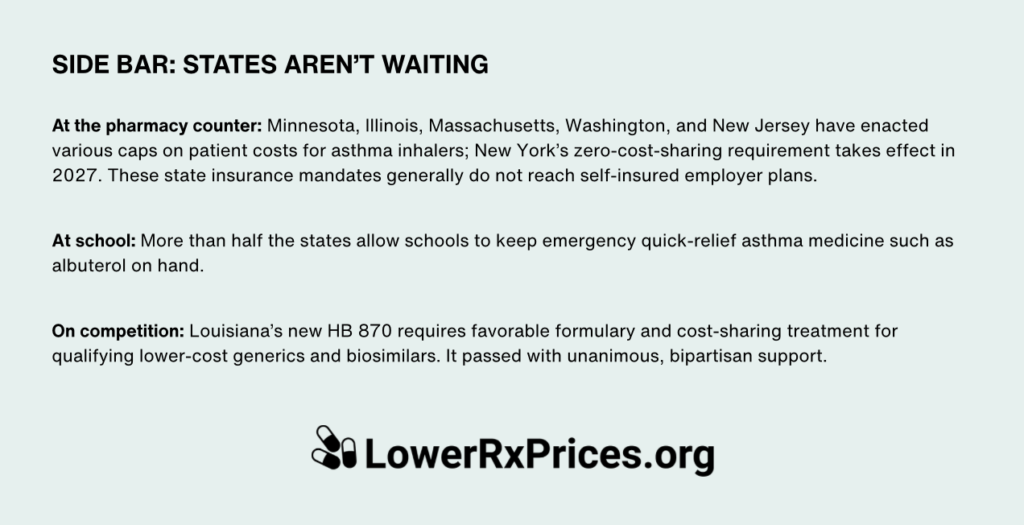
- Emergency Access. Make stock quick-relief medicine in schools workable nationwide – including standing orders, trained personnel and technology-neutral language.
Peak week arrives again later this month. The children who need an inhaler in the nurse’s office and another one at home will need them whether or not any of this has been settled. We would rather see the market reformed than watch another year of families managing around it – and we would welcome your thoughts on where the next policy push should be.