Rural Health Transformation: The Next Three Months
By ALDP Co-founders Michael Glassner and Jason Young
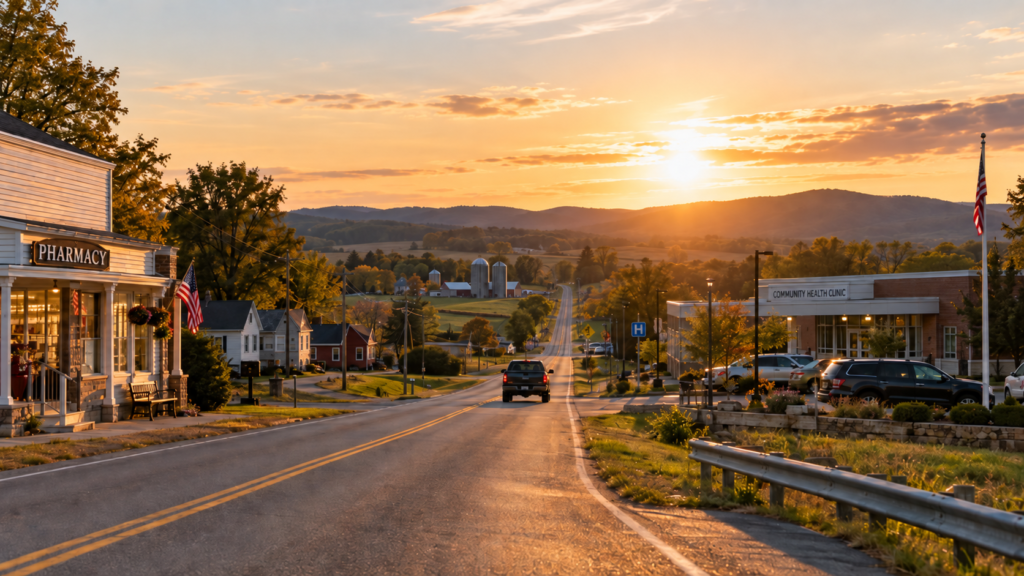
Oct. 7, 2026 – For patients in the small towns we’ve each lived in – in rural Kansas and Vermont – health care is often measured in miles, days, and dollars. How far is it to an emergency room, infusion clinic, doctor, or pharmacy? How long will it be until you can get treatment or the medicine arrives? And can you afford it when it does?
Each of those measures reveals a gap. But the gap shows up in health outcomes and life expectancy data, too. A generation ago, rural and urban adults survived their working years at about the same rate. Today, rural adults are 43 percent more likely to die from illness and other natural causes during those years than their urban neighbors. Rural Americans die of cancer at a rate about 14 percent higher than urban Americans.
Yet when rural patients are enrolled in clinical trials, where everyone receives the same standardized care, their outcomes essentially match those of urban patients. The gap comes from access, not from anything more intrinsic about people who live in rural America. The gap opened recently enough, and we believe it can be closed again.
That’s the backdrop for the Rural Health Transformation Program, the five-year, $50 billion fund that President Trump signed into law in July 2025. It is the largest dedicated federal investment in rural health in decades. Every state now has an approved plan and first-year funding – with first-year awards spanning from $147 million (New Jersey) to $281 million (Texas). The question increasingly is not what states proposed, but what those plans become. This is the time for the strongest implementation possible.
A national experiment in rural health
The 50 state plans are remarkably broad. They address:
- Workforce shortages
- Maternity and newborn care
- Emergency care
- Chronic disease
- Technology
- The sustainability and fates of rural hospitals, and
- Much more.
The federal Centers for Medicare & Medicaid Services (CMS), which is running the program, summarized all 50 states’ plans; read them, and you’ll see telehealth, remote monitoring, and new technology appear multiple times on almost every page.
There is also considerably more attention to prescription-drug access than a quick reading of the state summaries might suggest.
- Alaska is building pharmacy capacity, training pharmacists, exploring new ways to pay them, and testing technologies including drone delivery for communities where geography and weather can make medicine difficult to reach.
- Massachusetts proposes remote dispensing and automated prescription pickup in communities served by remarkably few pharmacies.
- Idaho, Oregon, North Dakota and others are experimenting with telepharmacy, kiosks, lockers or remote dispensing.
- Indiana proposes getting medicines into patients’ hands before they leave the hospital, using outpatient rather than hospital pricing.
These aren’t abstract ideas. They start with a distinctly rural problem: the medicine does little good if the patient cannot get to it.
We’ve dug deeper than just CMS’s summaries; you can find robust state-by-state application and plan information here. Our take is that states have thought considerably about how to get medicines to rural patients. They have thought much less about what those medicines cost once they arrive, which is a meaningful barrier to access we must work together to solve.
(Side note: see the new study by Harvard Medical School researchers that found “median prices charged by drugmakers have ballooned more than six-fold in nearly two decades, from about $39,000 in 2008 to more than $250,000 in 2025,” per USA Today. That amounts to an annual price hike of about 16 percent, the study reported. Such hikes land hardest on communities that are older and more likely to live on fixed incomes, which describes much of rural America.)
Miles, days – and dollars
Rural drug access has at least two dimensions.
- One is physical access. Is there a pharmacy nearby, or can a pharmacist serve a remote community? Can a prescription be delivered when roads, weather, distance or patients’ mobility needs become obstacles? RHT is producing some genuinely creative answers to those questions.
- The other dimension is affordability. Can the patient pay for the medicine? Is the state getting a reasonable price? Is there meaningful competition? Can purchasing power be used to make an expensive medicine less expensive? Those questions are much harder to find in the state plans.
That isn’t necessarily a criticism of the states. RHT was mainly designed around rural access, workforce, sustainability, care delivery, and technology. Drug-price accountability wasn’t one of the policy signals states were specifically encouraged to build around.
That leads to a key distinction: physically connecting a patient and their prescribed medicine is a different problem than making it affordable. Rural patients need us to solve both.
Cancer care shows what rural transformation can mean
Cancer may be the clearest example because some kinds of care simply cannot be digitized. Telehealth can connect a patient with an oncologist hundreds of miles away, but it simply cannot administer chemotherapy.
We read the plans alphabetically, so Iowa was fifteenth. But it stopped us in our tracks.
You have to read its actual RHT plan, called Healthy Hometowns, to get the full impact; it goes much further than the brief federal summary of it suggests. Iowa proposes hub-and-spoke cancer networks in which expertise can remain concentrated at larger centers while participating rural facilities provide chemotherapy, infusion, and follow-up care closer to home.
The model proposes four steps:
- Convert underused rural-hospital space into infusion clinics
- Purchase infusion chairs and pumps
- Upgrade pharmacy facilities (e.g., because oncology drugs require specialized handling, storage, and administration), and
- Build the workforce needed to support treatment locally.
In other words, transforming rural cancer care does not require building a comprehensive cancer center in every small town. Instead, it may mean making sure enough physical infrastructure remains locally that specialized expertise somewhere else can actually reach patients. That strikes us as correct.
A video visit becomes much more valuable when there is an infusion chair, trained nurse, pharmacy capacity, and appropriate medicine waiting on the other end.
Alabama is pursuing another approach, with five hubs planned for information technology, telehealth, maternal and fetal health, and cancer prevention and treatment by Year 5 of the program. Its first round of grants also includes expansion of community-based cancer screening.
There will be different models in different states – one of the virtues of having 50 laboratories working on rural health at once. If patients ultimately travel less and receive more care, we will have real signs of success.
An explicitly rural test
That brings us to another question ALDP will be watching.
Much of what states are funding – better data systems, AI, cybersecurity, electronic records, and remote monitoring – could improve health care almost anywhere. They aren’t unwise investments, and modern rural hospitals and clinics need modern tools, too.
But an explicitly rural program deserves an explicitly rural test:
What rural problem shrinks or evaporates if RHT succeeds?
- Does a patient drive 20 miles instead of 90?
- Can a rural hospital continue offering infusions?
- Does a town keep its pharmacy?
- Can someone get a prescription without losing half a day’s wages to go pick it up?
- Can a patient receive specialty medicine locally rather than traveling to a big city?
- Does a technology investment help preserve a service that otherwise would disappear?
Those are examples of how we’ll know whether states’ RHT investments worked.
The plans are largely set. Their implementation isn’t.
In many ways, it’s “go time.” CMS has made it clear that states can’t now add, delete, or significantly change the initiatives in their approved applications simply because they’d prefer to switch approaches. Major changes would require federal approval, and CMS has said those requests generally will be considered only later in the program when evidence shows an initiative is not working.
That doesn’t make the next four years predetermined. States have key decisions to make about implementation: which local organizations will participate, how programs are designed under a state’s approved initiatives, what gets emphasized, what outcomes are measured, how state agencies coordinate their work, and whether successful projects endure once federal funding ends.
The second RHT budget period begins Oct. 31, and the program then continues through successive annual budget periods into 2030. There are two big dates approaching, and both intersect meaningfully with the course of RHT in the states.
November and January
On Nov. 3, voters in 36 states will elect governors; 19 races have no incumbent on the ballot.
That sounds as though it could scramble the RHT map. But we don’t think so. The underlying plans will survive election night, mainly because a new governor cannot simply discard a federally approved initiative. Party control of the nation’s governorships isn’t expected to change much, either. What can change is nevertheless consequential.
New governors appoint health secretaries, Medicaid directors, and agency leaders. Incumbents who are reelected can change priorities and personnel. Any governor’s administration decides how aggressively programs are implemented, which outcomes receive attention, and how its government agencies work with local communities, hospitals, pharmacists, and clinicians.
In other words, governors have a lot of sway over the remainder of Congress’ five-year investment in RHT. If they’re new to office, they will inherit their states’ plans, but they will have substantial influence over what those plans become.
Then legislatures return to session in January or shortly thereafter.
State policy and possible changes in policy are part of RHT, too. When the feds reviewed RHT applications, states received scoring credit for commitments to adopt particular policies. They must now follow through under the program’s rules. Most of those commitments are due by the end of 2027. We believe that the upcoming legislative sessions are an opportunity to deal with rural-health problems that federal RHT dollars alone can’t solve.
That is especially important for prescription drugs.
- A grant can support telepharmacy equipment. State law determines what pharmacists are permitted to do.
- A grant can help preserve or start an infusion service. State purchasing and drug-pricing policies can affect what medicines cost.
- A grant can test new delivery systems. Legislatures decide whether promising models can continue after the grant disappears.
RHT funding and state policy shouldn’t be treated as separate conversations; in fact, they are deeply intertwined.
What we’ll be watching
ALDP sees rural pharmacies, hospitals, clinics, and infusion centers as public goods: they are shared infrastructure that an entire community depends on, whether or not a particular family needs it this month.
As RHT moves from plans to implementation, four questions will guide us:
- Is the whole access network treated as infrastructure? States understandably worry about keeping rural hospitals open. The pharmacy, clinic, infusion service, and specialty-care capacity surrounding those hospitals can be just as difficult to replace once lost.
- Is access measured from the patient’s side? We want to know how far patients travel to fill prescriptions, obtain specialty medicines, or receive infusions; how long they wait; and how many communities are one closure away from a much longer, more taxing trip.
- Are physical access and affordability both part of the conversation? A pharmacy within 10 miles is progress. A medication delivered by alternative means (e.g., a drone or a secure locker) is progress, too. But access is incomplete if the patient cannot afford his or her treatment.
- Does technology preserve or extend real care? Telehealth is extraordinarily useful when it connects expertise to a patient who’d otherwise have to travel a long way for it. It’s more useful still, though, when there’s a local pharmacist, nurse, clinic, hospital pharmacy, or infusion chair that can turn that remote expertise into actual treatment.
The opportunity ahead
We see the Rural Health Transformation Program as an investment worth helping succeed.
Congress and the administration have committed $50 billion to rural health, and all 50 states have plans underway. It’s time to make those investments work as well as possible for rural America.
That means learning from states with promising ideas, identifying gaps before they become permanent, bringing rural patients and their experience into implementation decisions, and helping policymakers connect RHT investments with the state policies that can make them sustainable.
We will contribute what we learn through our rural-access work, and we hope others will do the same.
Fifty states are trying several approaches at once. Over the next several years, some will work better, and some won’t. The opportunity is to recognize the good ones early, improve the ones that need help, cut what isn’t working, and make sure success is measured where rural patients experience health care every day: in miles, days, and dollars.