The Drones Are Real, But the Cure-All Is Not
By ALDP Co-founders Michael Glassner and Jason Young
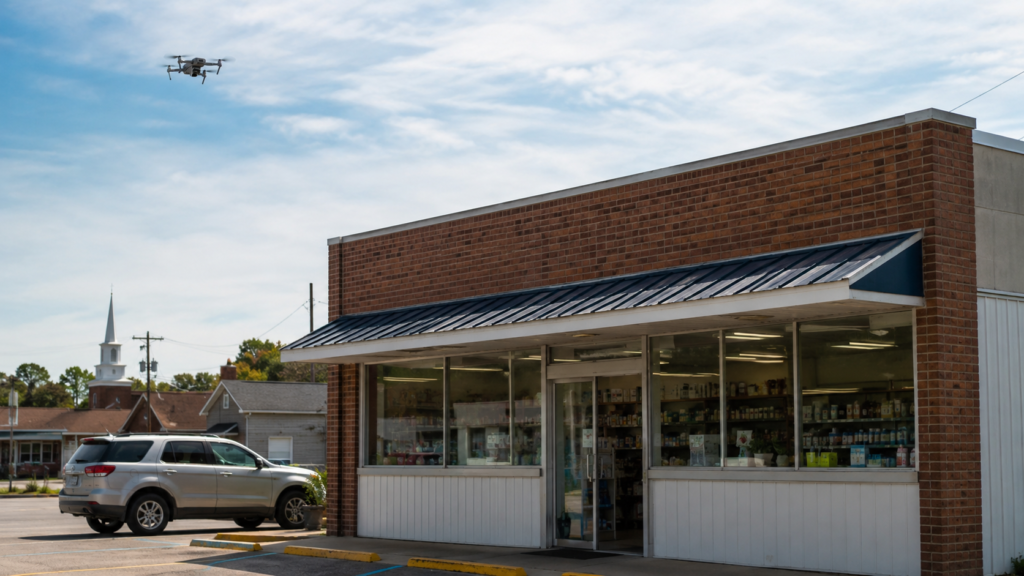
Aug. 12, 2026 – Watch the footage and you will not be unmoved. A small autonomous aircraft lifts off, climbs, flies a few miles, hovers above a house, and lowers a package into a yard on a tether. Inside is somebody’s medication. It took minutes.
As a free-market organization, Americans for Lower Drug Prices is not in the business of yelling stop or quashing innovation. We believe competition and technology have delivered enormous good in American health care, and we believe rural access is one of the most urgent unsolved problems in the country. When a company builds something that moves medicine to a patient faster, that is worth taking seriously. The companies doing this work deserve credit for their early efforts to build something that’s genuinely difficult to do.
But we have now read a great deal of coverage of medical drone delivery, and a pattern has emerged that concerns us. The word that keeps appearing is transformation (example 1, example 2, example 3). The framing keeps arriving at some version of this solves rural access. Somewhere between an impressive pilot program and a national policy conclusion, often a very large logical leap is being made on behalf of patients who are not in the room.
The distinction matters because drones may help solve a particular problem: delivery. Remote delivery from a pharmacy hub to a patient’s door is not itself new; mail order has done that for decades. Drones may make it dramatically faster and more flexible. But rural prescription access is a much bigger problem than transportation alone.
A drone may help a patient reach a medication. It does not determine whether that patient can afford it, whether the local pharmacy can remain open, or whether the medication itself is available on economically sustainable terms. Delivery is not affordability. Each is a different problem, and good policy should not conflate them.
We are not aviation experts – well, at least one of us isn’t. So everything below is either supported by published research and the experience of programs already operating, or stated plainly as a question we think deserves an answer – four questions in all.
First question: where are these drones actually flying?
Not, mostly, in the places the coverage tends to invoke.
The largest U.S. commercial drone-delivery networks are operating in and around metropolitan areas, or are coming online shortly – including Dallas–Fort Worth, Houston, Phoenix, northwest Arkansas and other fast-growing markets. Health-system programs launching now often operate within a relatively small radius of a hospital campus or distribution hub.
Those are real services, but they are not yet the same thing as solving access for a patient living thirty miles from the nearest pharmacy. The genuinely rural deployments remain much smaller. One frequently cited pilot on Virginia’s Eastern Shore reported three successful hypertension-medication deliveries within a two-mile radius. We say that with no snark. Early-stage pilots are supposed to be small.
The problem comes when a tiny rural pilot and commercial networks making thousands of deliveries a week are compressed into the same story and presented as evidence – evidence that the underlying rural-access problem is nearing resolution.
There is an economic reason to be cautious. Drone delivery runs on hub economics. A system needs aircraft, infrastructure, staffing, regulatory approval and enough orders within a workable radius to spread those fixed costs across many flights. The economics improve where people and prescriptions are concentrated.
Which means the patient most difficult to serve economically may be the patient who lives farthest from everything – the exact patient so often invoked in the promise of rural drone delivery.
We are not saying drones will never reach that patient. We hope they do. But we are saying that if you had to guess who gets served first and who gets served last, the geography of the current rollout offers an important clue.
Second question: what can they actually carry?
In physical terms, current delivery drones generally carry only a few pounds, although some newer systems can carry a multiple of that. That capacity is improving, but real limitations remain. Pill bottles are easy payloads; larger liquid volumes or supplies needed in quantity can quickly become more difficult.
Furthermore, controlled substances are excluded from prominent medical-drone programs because of diversion and security concerns. And temperature-sensitive medications present another challenge, although cold-chain drone delivery has been successfully demonstrated using validated packaging and monitoring.
Those constraints are reasonable. We would not want safety standards relaxed merely to make the technology appear more versatile. They do mean, though, that drone delivery is not a universal substitute for existing pharmacy infrastructure. Different medicines bring different requirements for security, temperature control, handling and patient counseling.
That distinction matters particularly in rural communities, where the hardest medications to obtain may already require more clinical and logistical support than dropping a package in a yard.
Third question: what happens in winter?
One of us is writing this post from Vermont. Here, some of the days when getting to a pharmacy is hardest are also the days when aviation becomes most difficult: snow, ice, extreme cold, and high winds.
The technology is more capable than skeptics might assume. In one Japanese island study, 60 of 62 medication deliveries were completed successfully, including under challenging conditions. But the researchers also reported an important limitation: the aircraft used could not operate in cold or snowy weather when icing on the wings presented a risk.
That is not an argument against drones. It is, however, an argument for describing their reliability honestly. If drone delivery is presented as a lifeline when roads become difficult or dangerous, policymakers need to know when that lifeline works and when it does not.
Other practical questions deserve consideration as these programs scale. What happens when a package arrives and nobody is home? What safeguards protect medication left outside? How are privacy and tracking handled? What happens when weather or technical problems interrupt a scheduled delivery?
None of these questions is a reason to stop; they are reasons to set expectations before a promising technology becomes a policy assumption.
Fourth question: who is paying, and who can afford to compete with “free”?
Several programs now offer drone delivery to eligible patients at no additional charge. That is good for those patients. But: no additional charge to the patient does not mean no cost. Somebody is paying for the aircraft, infrastructure, staffing, maintenance, and operations. That raises a competition question that rural policymakers should confront early.
The independent pharmacist in a town of eighteen hundred people, squeezed by margin pressures and discount and e-commerce competition, may have no realistic ability to build an aircraft-delivery network or secure access to one on competitive terms. That pharmacy may also find that drones aren’t just delivering medications, but also other items it sells from the front of the store – compounding the effect on the business.
We support competition. We are not going to tell anyone who may or may not own a drone company.
But we should be clear about our concerns. In many rural communities, the pharmacist is part of the health care infrastructure: the vaccine, the blood-pressure check, the medication consultation, or the person who notices an interaction or realizes that a patient has stopped filling an important prescription.
Lose the storefront and you have not simply traded a pharmacy for a drone. You have traded a health care presence for a delivery service. We have said before and will say again: a rural pharmacy is often the last remaining point of care for miles, and policymakers should account for that before implementing policies that may contribute to rural pharmacies’ disappearance.
Delivery is not affordability
This is the distinction that gets lost most easily. Drone delivery moves medication. It does not move prices.
A drone can bring a drug to someone more quickly. That could be valuable if transportation were the main problem. But it does nothing to change the underlying price of the medication. That price begins with the manufacturer’s list price – a burden felt acutely by patients who are uninsured or underinsured and by those with fewer alternatives when a local pharmacy disappears.
So when an article treats drone delivery as the answer to rural prescription access, watch what has happened to the word access. It has quietly stopped meaning “can obtain and afford the medication” and started meaning only “can physically receive the medication.” Those are not the same.
Our concern is not the technology. It is the permission structure that sometimes grows around technological optimism: the legislator who decides the drug-price problem can wait or the transparency bill can wait because innovation is coming. We welcome the innovation. But innovation is not a substitute for policy. ALDP’s core mission is to advocate for prescription drug affordability, access, and competition.
What we would ask for instead
Three things, none of which requires anyone to slow down.
- Set expectations honestly. Regulators, health systems and companies should be specific about service radius, weather and other limitations, excluded drug categories, and patient eligibility. “First in the nation” and “within five miles of our campus” belong in the same sentence so we have a more accurate picture.
- Do not confuse the flight with the storefront. Drone delivery should be evaluated on whether it adds a delivery channel or substitutes for a point of care. Those are different outcomes. A drone can replace a trip; it cannot necessarily replace the health care functions performed by the pharmacy at the other end of that trip.
- Look for models that strengthen access. There is a version of this technology that complements local pharmacy rather than routing around it, and it already exists in miniature. A pilot in Crisfield, Maryland, ran deliveries through two local pharmacies, with a hometown pharmacist describing the service as a potential lifeline when flooding closes the roads. We are not arguing that every drone network must operate this way, but we think it is one model worth watching: technology extending the reach of an existing rural health care provider rather than assuming that provider must be replaced.
The goal should not be to protect one business model from another, but rather, a level playing field and fair and open competition.
We hope the drones work.
We hope they work in January in Vermont. We hope they eventually reach the patient 30 miles out, not just the patient five miles out. We hope a rural pharmacist can put a prescription on one as easily as a national corporation can. On the day all of that happens, we will celebrate it.
And through it all, we will keep asking what the medication on board costs.
Because that number is still the fight.