The Forecasts on Drug Prices Are In. Waiting Is the Expensive Choice.
By ALDP Co-founders Michael Glassner and Jason Young
Aug. 5, 2026 – When you are already struggling to afford your medications today, the year 2034 can feel beside the point. But for the officials who oversee our public programs, looking that far ahead is a core part of the job. Over the past six weeks, two sets of federal forecasters showed their work.
What the Forecasters Found
In late June, the actuaries at the federal Centers for Medicare & Medicaid Services, or CMS, published their outlook through 2034.
They expect the nation’s total health care bill to grow by 5.4 percent a year, faster than the economy grows. Put another way, health care claimed 18 cents of every dollar the country produced in 2024. By 2034 it will claim nearly 21 cents.
Of everything we buy in health care, the medicines we pick up at the pharmacy are expected to rise fastest. Through 2034, retail prescription drug spending is projected to grow by 5.7 percent a year – faster than hospital spending (5.2 percent) and spending on doctors and clinical services (5.5 percent). The near-term increase is even steeper: 11.1 percent in 2025, easing to 8.2 percent in 2026.
To be clear, the actuaries weren’t looking only at Medicare’s spending on medications, but at everyone’s – including states’, businesses’, and individuals’ costs. And too little has been done by any legislature, in Congress or in the states, to rein in the spending that happens outside Medicare.
Over the same years, fewer Americans will carry health insurance. The number without coverage is projected to climb from about 28 million to about 33.5 million. Millions more people will reach the pharmacy counter without insurance to absorb part of the cost.
Then, on July 29, the Congressional Budget Office – the nonpartisan scorekeeper Congress relies on – explained why its Medicare prescription drug forecast had worsened so sharply. Back in February, CBO estimated that Medicare would spend roughly $700 billion more than it had previously projected over the next decade on its prescription drug benefit, known as Part D. Most of that revision came after private Medicare drug plans submitted unexpectedly high estimates of what it would cost them to cover beneficiaries.
The new report also reversed an earlier prediction. CBO had expected savings from Medicare drug-price negotiation and inflation rebates to outweigh the added cost of redesigning the Part D benefit. It now expects the opposite: negotiation and inflation rebates are still saving money, but less than anticipated, while the benefit redesign has proven substantially more costly.
No Single Cause
It would be convenient to pin all of this on one law or one decision. The record does not support that. CBO’s revised outlook reflects several moving parts:
- The first round of Medicare negotiations reduced net prices, but by less than CBO originally assumed; later results came closer to its revised expectations.
- Inflation rebates are still saving money, but less than expected. Because overall inflation rose faster than CBO had projected, manufacturers could raise prices further before owing the same rebate.
- The Part D redesign – the one that capped what seniors pay out of pocket – has proven much more costly, in part because lower out-of-pocket costs allowed patients to use more medicines.
The broader forecasts also reflect forces no legislature directly controls. Americans are aging. People are using more medicine, including costly specialty drugs. And new, more effective treatments are reaching patients.
None of that makes helping people afford their medicines a failure. We are glad there are more great-grandparents, that better medicines exist, and that lower out-of-pocket costs are helping more patients take the prescriptions they need. We would not undo any of it.
Which is exactly why the part we can control deserves more attention, not less. When the forces we cannot change are pushing this hard, we had better get serious about the ones we can. CBO’s accounting points somewhere useful: Medicare negotiation and inflation rebates targeted what the program pays and saved money, even if less than anticipated. The benefit redesign made medicines more affordable for patients without necessarily making the medicines themselves less expensive.
That relief counts. This is not an argument against better coverage. It is an argument against stopping there. Protecting patients from high prices is essential, but it is not the same as confronting the prices themselves – an especially important distinction in a country where prescription drug prices are two to three times higher than in comparison countries.
Who Pays in 2034
Follow the money to its source and the answer is uncomfortable in a useful way.
Government programs already cover more than half of what Americans spend on medicines picked up at the pharmacy. Medicare’s share is expected to rise from 35 cents of every dollar in 2024 to about 40 cents going forward – roughly $324 billion a year by 2034. Those dollars ultimately come from taxpayers and beneficiaries.
But Washington is not the only government at the counter. Every state finances prescription drug coverage with state funds.
Start with the role most people overlook: a state is also a large employer. Across the country, state-supported health plans cover teachers, troopers, highway crews, university staff, corrections officers, and the retirees who spent their careers in those jobs – along with many of their spouses and children. Those plans pay pharmacy claims with public and employee dollars under contracts the state selects and oversees.
States also share the cost of Medicaid, although that program operates within an extensive federal framework. Every prescription filled under a state’s Medicaid program is partly a state expense, paid from the same budget that funds schools and roads.
Taken together, that makes prescription drug spending a major responsibility for every governor and legislature.
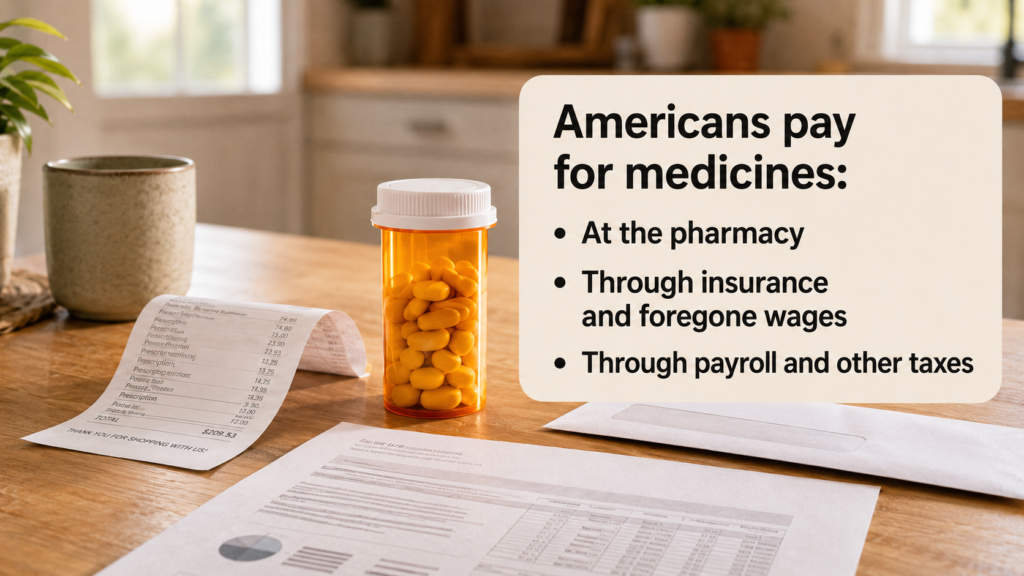
For many families, the prescription drug bill arrives more than once: at the pharmacy counter, through insurance premiums and foregone wages, and through the taxes that finance public programs. Whether you ever pick up a prescription or not, the bills we are talking about are our bills – Americans’ pharmacy bill.
That is an ordinary reason to ask for accountability. When we, the public, buy something, we, the public, get to see what we paid and what we got. We expect that of a contract for a highway or a new school. A public program projected to spend $324 billion a year on retail prescription drugs deserves the same scrutiny, for the same unremarkable reason.
Why Waiting Is the Expensive Choice
Last month, we wrote that nearly every health care debate begins with how to divide the prescription drug bill rather than why the bill is so high. CBO has now provided a vivid example of the difference.
Delay is not free. Every year lawmakers wait, the next year starts from a higher number, and the fix that eventually arrives has to be sharper and more sudden.
Waiting is also easy. It is always easy, right up until it isn’t. Nothing forces a legislature to act on drug prices. There is no siren, no bell at the end of the period. The cost builds quietly – in rising drug spending, insurance bids, and budget forecasts – and by the time it is impossible to ignore, the incremental and least-disruptive fixes are already behind you.
States do not have to wait for Washington. Every state legislature will meet next year. Every one of them can ask what its own health plans are paying for medicine and why.
Begin with a straightforward comparison: For each medicine the plan covers that also has a Medicare-negotiated price, what is the state employee and retiree plan’s true net cost after rebates, fees, and other concessions? How does it compare with Medicare’s price? And when the state is paying more, what explains the difference?
Those answers can help states bargain for a better deal – and make unexplained price gaps harder to defend.
None of this requires predicting the future. The forecasters published theirs, in public documents, in plain arithmetic. They tell us where this path leads.These forecasts are not prophecies. They are warnings, and warnings help only when people act on them.