Your Zip Code Shouldn’t Be Your Destiny
By ALDP Co-founders Michael Glassner and Jason Young
July 26, 2026 – Peabody, Kansas, sits in Marion County, about an hour north of Wichita. Manchester, Vermont, lies in the Green Mountains, several hours north of Boston. One of us grew up in the first place. One of us lives in the second. They do not look much alike, but they have a great deal in common.
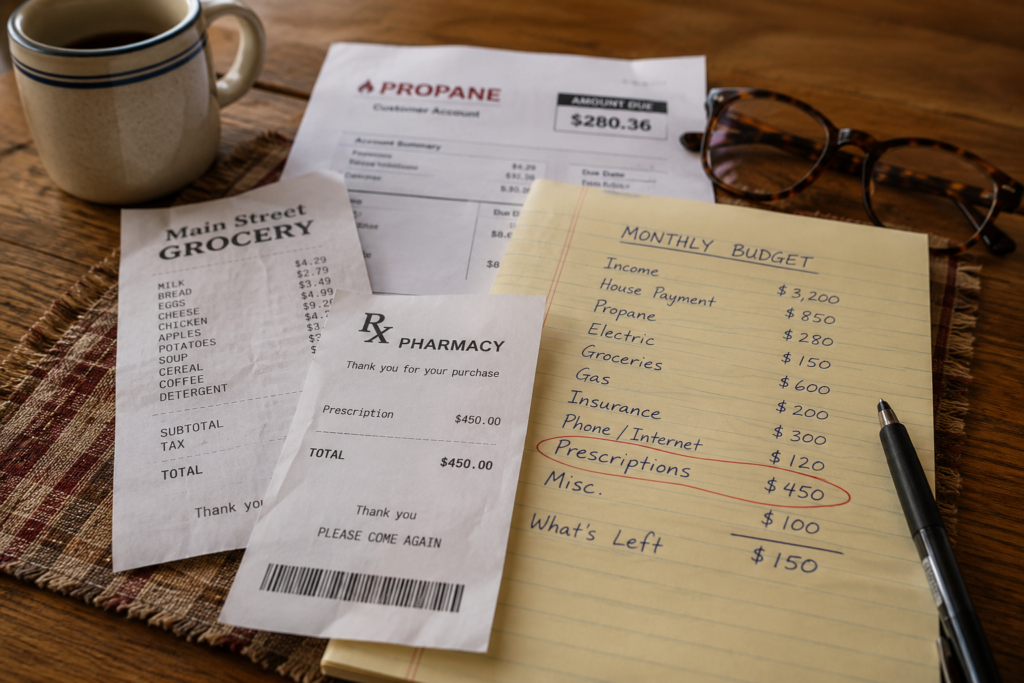
For many families in small towns, the arithmetic does not leave much room. The money that comes in each month is the money that comes in each month. It covers groceries, gas, propane, a meal out on a good week, and whatever the pharmacy charges. When one of those numbers climbs faster than the others, something else has to give.
That arithmetic carries particular weight in rural America because rural America is older. The U.S. Department of Agriculture’s Economic Research Service reports that, in 2023, 21 percent of the nonmetro population was age 65 or older, compared with 17 percent of the metro population.
The aging of rural America becomes even clearer at the county level. In 2000, only 292 nonmetro counties – 15 percent of the total – had populations in which at least one in five residents was age 65 or older. By 2023, 66 percent of nonmetro counties had crossed that threshold.
These are communities where many households live largely on Social Security, pensions, farm income, or wages that cannot readily expand when costs rise.
The consequences extend beyond a single household. A dollar spent at the grocery store, the diner, the feed store, the pharmacy, or the hardware store on Main Street is more likely to keep circulating locally. It pays a clerk, who pays a mechanic, who buys lunch. A dollar absorbed by an unnecessarily high price set far from the community is much less likely to return.
The Gap Is Newer Than People Think
Rural Americans are also experiencing substantially worse health outcomes than their urban neighbors, and the trend is moving in the wrong direction.
A generation ago, people in rural and urban communities lived through their working years at roughly the same rate. Today, rural adults are 43 percent more likely to die from illness and other natural causes during those years than their urban counterparts.
That is not an ancient disparity baked into the landscape. It opened within a single working lifetime, which means it is not beyond our power to narrow.
Your zip code should not determine how long you live. But closing that gap requires being honest about which parts of the problem a state legislature can reach, and how quickly.
A Lever Within Reach
Think about what a rural patient may need over a lifetime: primary care, hospital beds, surgeons, oncology services, emergency transportation, and medication.
Much of that list is difficult to rebuild. You cannot legislate a surgeon into Marion County. You cannot order a shuttered maternity ward to reopen in southern Vermont. Workforce shortages and lost facilities take years, sustained investment, and often a good deal of luck to overcome.
Medication access has rural challenges of its own, including pharmacy closures, long travel distances, and limited specialty care. But prescription-drug affordability is different in one important respect: the medicine already exists, the prescription is already being written, and the distribution system is already delivering it. A state does not have to train a new clinician or construct a new facility before it can begin addressing what that medicine costs.
Medicare has shown one possible path. Its Drug Price Negotiation Program produced negotiated prices for an initial group of medicines that millions of Americans rely on and that account for some of Medicare’s highest prescription drug spending. These negotiated prices – called Maximum Fair Prices – created a federal benchmark that did not exist before. States do not have to invent an affordability standard from scratch. They can design policies tied to Medicare’s negotiated prices and seek to extend those savings to people the federal program does not reach.
Where direct price action is not available, transparency and accountability still matter.
Insulin demonstrates why. Years of hearings, reporting requirements, patient advocacy and bipartisan scrutiny exposed a pricing system that had become impossible to defend. Federal policy then changed the financial equation. Congress removed the cap that had prevented Medicaid rebates from exceeding a drug’s price, creating potentially substantial new liability for manufacturers whose insulin prices had risen far faster than inflation.
The impending change was a powerful balance-sheet incentive for manufacturers to reduce list prices. That does not make transparency and public scrutiny incidental to the story. It shows how the pieces worked together: scrutiny established the problem, legislation changed the incentives, and manufacturers responded by substantially reducing the list prices of several widely used insulins.
No single hearing or transparency law produced that result by itself. But neither did the pricing system correct itself voluntarily. Sustained public attention helped create the political conditions for a federal policy change that made keeping those prices high increasingly costly.
Oklahoma pushed further this year by enacting a law designed to open a pathway for lower-cost biosimilar insulin competition. The results will take time to measure, but the principle is sound: states can and should do more than document unaffordable prices. They should use every practical tool available to increase competition, demand accountability, and lower costs.
A Real Difference This Year
Lower drug prices will not close the rural mortality gap by themselves. They will not rebuild a rural hospital or place an oncologist in Peabody or Manchester.
But that is not an argument for leaving prescription costs untouched.
Drug affordability is one part of the rural health challenge that states can begin addressing now, through institutions they already have and for people they already cover. They can use purchasing power more effectively. They can demand transparency. They can encourage generic and biosimilar competition. And they can work for greater fairness by extending Medicare’s negotiated prices to working-age people who are currently left out.
We cannot guarantee that every medicine will be available close to home. But we can work to lower what patients pay when it is.
In towns running on arithmetic that does not leave much room, that is not a small thing.