Chemotherapy Deserts, Part Two: Why the Market Broke – and Who Pays the Price (Part 2 of 2)
By ALDP Co-Founders Michael Glassner and Jason Young
In Part One, we re-told the story of Herlinda Sanchez and the expanding geography of chemotherapy deserts – the communities across rural America where cancer treatment services have simply vanished. Today we want to examine why this is happening. Because the forces driving it go to the heart of what Americans for Lower Drug Prices was founded to address.
The Economics of Rural Cancer Care Are Broken
Twenty-five years ago, a hospital pharmacist could pull a vial of chemotherapy from the shelf and administer it bedside.
Where older chemotherapies cost hundreds of dollars per dose, many modern therapies – especially biologics and immunotherapies – can cost hundreds of thousands per course of treatment.
The newer classes of therapies also require specialized pharmacists, oncology-certified nurses, and sophisticated infrastructure. The financial risk of maintaining an infusion program has become enormous. For a small rural hospital already operating on razor-thin margins, serving a population that is older, sicker, and less insured, it sometimes becomes unmanageable.
The math is unforgiving. Rural hospitals can’t generate the patient volume that large urban cancer centers use to spread fixed overhead. Only 3% of medical oncologists practice in rural areas, despite 20% of the population living there. And when an insurer disputes a claim for a drug that costs six figures, the financial exposure to a small rural hospital can be existential.
Because hospitals must purchase these drugs upfront and are reimbursed later – often unpredictably – the financial risk of carrying high-cost therapies falls directly on the provider.
Meanwhile, the drugs that were once the financial backbone of rural infusion programs – older, generic injectable chemotherapy agents like cisplatin and carboplatin – have become so cheap that manufacturers have little incentive to produce them reliably, leading to persistent shortages. The drugs in shortage average about $2 per vial. The drugs not in shortage average $1,423.
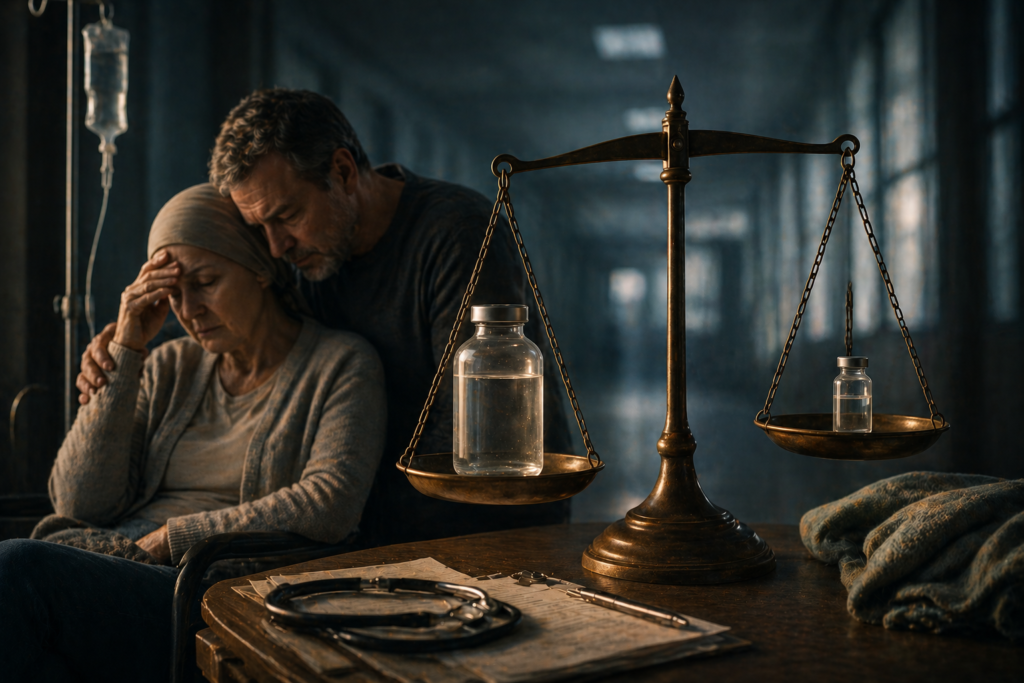
This is the economics of cancer care in rural America: high prices on complex new drugs make them hard if not impossible to stock, while low prices on essential generics can lead to supply chain failures that disrupt treatment. The rural patient is caught between both ends of a broken market.
It is worth being clear about one thing: the choice facing rural cancer patients is not simply “hospital infusion unit or nothing.” Specialty pharmacies and community oncology clinics represent a genuine middle ground – and an important one. Oral chemotherapy, which now accounts for the majority of cancer drug treatments, can often be dispensed by a specialty pharmacy and delivered directly to a patient’s home, eliminating the need for repeated infusion center visits entirely. And some specialty pharmacies have developed the capability to support IV-administered therapies as well, extending the reach of oncology care beyond what hospital-based programs alone can provide. These settings deserve to be part of any serious conversation about rural cancer access. But they operate within the same broken pricing environment. When the drugs they dispense carry six-figure price tags, the affordability problem follows the patient regardless of the care setting.
Cancer Care Is a Canary in the Coal Mine
We focus on chemotherapy deserts not because cancer is the only rural health crisis, but because it is one of the most visible and measurable signs of a deeper structural failure.
Forty percent of rural hospitals are currently operating at a financial loss. More than 400 are considered vulnerable to closure. The same states that have lost the most rural cancer treatment also have the most financially precarious rural hospital systems overall.
And the problem compounds itself. When a hospital’s cancer program closes, patients don’t simply find some other nearby equivalent – often there isn’t one. What remains may be a specialty pharmacy capable of managing oral therapies, a community oncology clinic an hour away, or nothing at all. Each step down that ladder often can mean less direct clinical oversight and fewer integrated support services. When the specialty pharmacy closes too, or becomes unaffordable because the drugs it dispenses are priced beyond what patients or their plans can sustain, the ladder runs out. Communities lose not just a care option but their economic anchor and their confidence in the future. Every closure is another data point on the same map of diminishing access.
Diagnosing the Headache
Americans for Lower Drug Prices was founded on a simple conviction: the high price of prescription drugs in America is a policy failure, not an inevitability. We believe in free markets – and we know that free markets require transparency, competition, and accountability to function. What we have in the American drug pricing system is not a free market. Monopolist pricing is the dominant feature, and it comes at the expense of patients.
When the cost of a single cancer drug can exceed what a small rural hospital earns in a month, access to care becomes a geographic lottery – determined by where you were born, not what you need.
ALDP is a bipartisan organization because protecting access to affordable medicine in rural America is not a partisan issue. Republican, Independent and Democratic voters in rural communities are all watching their drug prices increase and their access to care shrink. They are all hearing about neighbors who drove hours for cancer treatment.The diagnosis is in. The headache is real. As we look ahead, we’ll be back with a thorough discussion of the treatment – policy options that will genuinely help patients at those moments they need it most.